
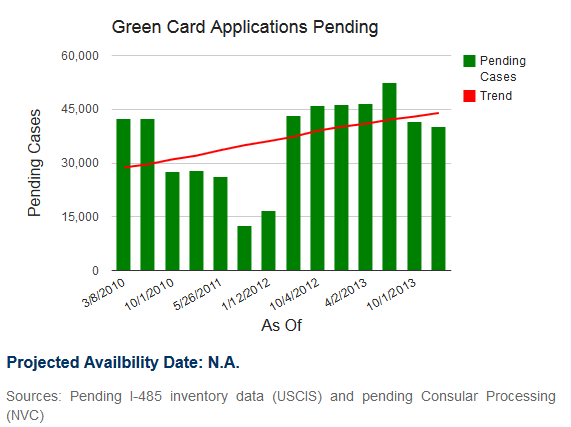
The family-based green card is one of the most popular ways to become a U.S. lawful permanent resident. Despite this popularity, however, the process is not as straightforward or fast as many people perceive it to be. This is because there is a limit to the number of U.S. green cards that can be issued in a year. On this page, we explore family-based green card processing time, factors that influence the length of processing, procedures for applying, and more.
It Takes Just 90 Miniutes to Start Your Green Card Application
Many people choose to work temporarily in the U.S. through nonimmigrant visas, but others want to make this country their permanent home. Immigrant visas, or green cards, allow for these foreign nationals to live and work in the U.S. for ten years at a time. One of the more common types of green cards that people seek is the EB-3 green card due to its relatively low requirements. However, this also makes it a popular green card process, which can impact the time it takes to obtain one. Keep reading to find out what else goes into the EB3 visa processing time in 2023.
No matter who you speak to along the immigration journey, one topic looms darkly over the conversation: priority dates. You may have heard of them or you may even be currently waiting for your priority date to be current right now. This article will serve to educate you about what green card priority dates are, how they work, why the wait is so long, and what your options are when it comes to shortening your waiting time.
IMPORTANT UPDATE: There is a significant advancement of Priority Dates in EB-3 India category in October 2020 VISA BULLETIN. If you are considering downgrading your petition from EB-2 to EB-3, read THIS ARTICLE.
In order to understand and estimate how long it takes to get an EB-3, we must first go over the steps that are involved in preparing and petitioning for this green card.
I’m an individual representing myself or my family
Explore your immigration options.
I’m an individual
I’m representing a business or organization
Speak with a Corporate Immigration agent.
I’m a business
August 25, 2021 (Updated August 26, 2021) 3 min. read
Changing your status to that of a lawful permanent resident of the United States is a significant step. The wait can be lengthy and stressful. You’re probably wondering what occurs after you file Form I-485, Application to Register Permanent Residence or Adjust Status, and how long it will take for you to get your green card. We’ve outlined the I-485 processing period and the many phases along the way.
US Green Card Processing Time
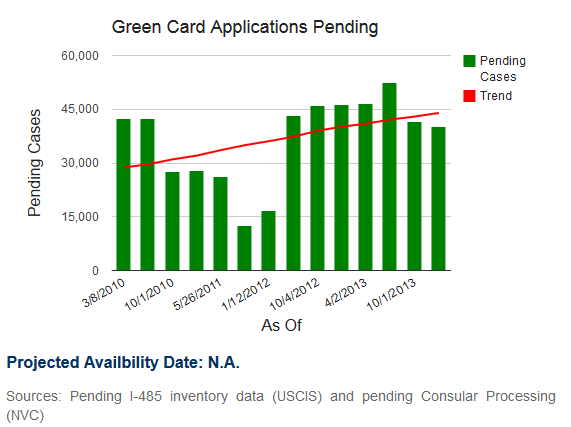
Short Answer: Really long time. Several Years of Indian National on EB2 and EB3. And several years of wait time for Chine Nationals.
Some frequently asked questions
Green Card Wait time depends on your country of birth, not country of citizenship. So, the wait time for Green card to USA depends on your country of Birth.
Majority of the Green Card is issued through Employment Based or Family Based Category. In this article we will consider the Employment Based Category.
Green Card Categories
Every year 140,000 applicants are given US green card in employment based categories. Within that 140,000, each country can have cap, which is 7% of 140,000 green card (9,800).
How Long to Get Green Card
According to May Visa Bulletin 2014
The above table shows the priority dates for EB1, EB2 and EB3 categories for India and China.
If you apply for Green card in EB1 Category, you can get it in GC in less than one year.
For EB-2 Green Card submitted on November 15, 2004 is being processed for Indian Nationals ( born in India).
That’s about 10 years wait. But, in theory, it takes about 4 to 6 years.
Pending Green Card Applications for EB2 – India
Pending EB2 Green card applications for India – April 2014
Example Processing Time EB3
- Start Masters Degree from Fall 2014
- Complete Masters in Summer 2016 ( 2 years)
- You can expect to get US Permanent Residency in 2030.
For EB3, unless the law changes, wait times is unbelievably long.
Pending Green Card Applications for EB3
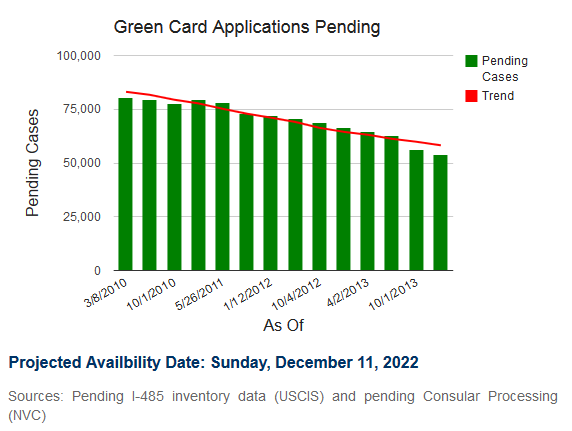
Pending Green Card Applications for EB3 – India
Above case figures and examples should give an idea on how long it would take for you to get the Green Card.
Image Source – ilw.com
If you think getting H1B Visa via lottery is complex, then you would realize the pain and long wait times for India and China is much more painful.
Why long Wait Times?
You might be wondering why does it take so long for processing green card and why so many petitions are in pending state?
Read the articles in the Green Card Series :
How Long Does it Take to Get a Green Card?
It takes 7 to 33 months to process a Green Card application. The Green Card processing time depends on the type of Green Card you are applying for, the location of the processing office and other factors.
Family Based Immigrant Visas Processing Time
There are different family based visas and some of them have yearly caps. Yearly caps mean that for a particular visa, only a few people each year will get it. After reaching the yearly cap, those who have applied that year but did not get the application processing must wait until the next period.
So if one of the family based visas are given to only 1,000 people, if you apply as the 1,001st person, you will be processed next year. Even further, if you are the 2001st person to apply, the processing will begin after two years. This means that processing times can be long and extend for years.
There are two sub-categories to the family-based immigrant visas:
How long does it take to get a green card through marriage?
The time it takes to get a Green Card through marriage is from 10 to 13 months. The IR-1 visa which is also known as a marriage green card, therefore the processing time is also much shorter than the Family Preference Visas.
Family Preference visas
Each year, the US government gives 140,000 employment visas to different categories based on percentages. The waiting times for processing are different depending on the demand for that visa.
The visa applications based on employment are processed on a first-come, first-serve basis.
To make the processing time shorter, make sure that all your documents are in order and that there are no mistakes in your application. If there are mistakes or missing documents, the USCIS will send the application back. This will extend the processing time even further.
Returning Resident Immigrant Visa Processing Time
A returning resident visa is for those could not return to the US within one year of absence, for strong reasons. You must prove to USCIS that you intended to return to the US but had no way of doing so.
After going through the application process, you will have to go through a visa interview again. The consular officer at the US Embassy will inform you whether you got the returning resident visa.
This means that there is no processing time in terms of this visa. You will know immediately whether you got your Green Card back.
Diversity Visa Processing Time
Diversity Lottery winners are announced within 7 months after the initial lottery applications. The visa processing after the announcements takes another 7 months. The applications are usually in October or November, after which applicants must wait for them to be processed.
The US State Department processes the applications and notifies the applicants when completed. It is up to them to decide when they can post the results, and applicants must continuously check their statuses on their website.
If you are then one of the selected people, you can apply for the Diversity Visa. You will need to complete the forms and submit supporting documents, which might take a few months. Even then, you must wait for the US Embassy to process your visa request and make a decision. Overall, you can expect to immigrate to the US around 2 years after you completed the initial application.
When Should I Purchase Health Insurance for Green Card Holders?
It is recommended that you purchase a health insurance plan right before your trip to the United States. Here you can learn how to obtain health insurance for Green Card holders.
Did you find this page helpful?
Family-Based Green Card Wait Times
The processing times vary significantly among the subcategories, sometimes ranging between one and more than ten years. For instance, F2A applicants (spouses and minor children of lawful permanent residents), usually enjoy the shortest processing times. This is because a higher priority is given to them, coupled with the fact that the subcategory has the largest annual quota among family-based green card preferences.
https://youtube.com/watch?v=t0vY6Wknu0A%3Fstart%3D1%26feature%3Doembed
Status Adjustment Application for Applicants In the U.
If you are in the United States, you will need to petition the USCIS for an adjustment from your current non-immigrant status to an immigrant permanent resident status the moment a visa number becomes available to you. You will need to file the I-485, Application to Register Permanent Residence or Adjust Status to adjust your status and receive your green card.
On average, the I-130 filed by your sponsor takes between 6 to 12 months to be processed. The USCIS processes the petition on a first-come, first-served basis. Your sponsor can expedite the process by submitting the form as early as possible. Also, the form must be properly filed with all the required documents attached.
For any missing documents, there will be a Request for Evidence (RFE) notification from the USCIS. This will lead to a delay and longer processing time, as your application process will be placed on hold until the documents are submitted.
Immigrant Visa Application for Applicants Outside the U.
If you are outside the U.S. and there is an immigrant visa number available for you (meaning your priority date is current), you will need to visit the U.S. consulate or embassy in your home country to continue the family-based green card processing. You will get your visa number and schedule an appointment for your immigration interview.
You will also need to complete a biometric screening, medical examination, and submit the necessary documentation. To do this, you will need to complete a DS 260, Application for Immigrant Visa and Alien Registration and bring the confirmation page to the interview.
Fast and Reliable Service to Get Your Family Green Card Sooner
Can I Bring My Relatives to the U. with an EB-3 Green Visa?
Just like every other employment-based green card, if your EB-3 visa is approved, your immediate relatives (spouse and unmarried children under the age of 21) can join you in the U.S. If your EB-3 visa was approved under the skilled and professional category, your spouse can apply for the E34 visa, and your children can apply for the E35 visa. If you are an unskilled EB-3 worker, your spouse and children can apply for the EW-4 and EW-5 visas, respectively.
If the application is approved, your spouse can apply for an Employment Authorization Document to be able to work lawfully in the U.S. while the permanent residency application is being processed.
Employment Authorization Documents
Fastest Way to Bring Siblings to the USA
The most effective way to bring a sibling to the United States is in the steps we mentioned above:
Benefits of EB-3 Visa
There are a number of benefits to having an EB-3 visa including:
What is the Overall EB-3 Processing Time?
So the real question is: how long will it take to get my EB-3 green card?
In order to answer this, we need to break down each step of the EB-3 process.
PERM Labor Certification Processing Time
PERM Labor Certification Process can take as little as 6 to 9 months after the ETA-9089 application is filed. This does not include the 30 days of recruitment required and the 30 days that need to pass after the end of the recruitment before applying. Here is the breakdown:
NOTE: If your employer is audited, it could extend the processing time up to a year and a half.
Six Months or 15 Days
Under normal circumstances, the I-140 petition takes about six months to process without premium processing. However, if the USCIS sees that your priority date will not be current for some time, your petition may be pushed back to a date that is closer to your priority date. If your employer uses premium processing, the I-140 will be processed within 15 calendar days.
The I-140 premium processing fee is $2,500.
Wait Time for Priority Date
The wait time for your priority date varies depending on your country of origin. However, for most countries, there is only a wait time of a few months. It will also depend on whether you are going to adjust your status in the U.S. or use consular processing outside the U.S. Each of these two routes has its own processing times and requirements.
I-485 Petition for Status Adjustment
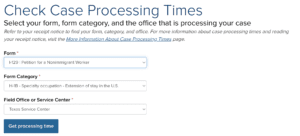
It may also take four to six months for your I-485 to be processed. There is no way to expedite this processing time. Sometimes, it may also take longer than six months depending on the service center in charge of your case. To get the most accurate sense of EB3 visa processing time, use the USCIS processing time tool.
Enter your specific form into the fields and your field office/service center processing your case, then click ‘Get Processing Time.”
Overall, for applicants from countries other than India, China, and the Philippines, you can expect your EB-3 processing time to be about a year and a half to two years. For citizens of those three countries, the processing time may be much longer. Don’t hesitate to contact your immigration attorney to learn if there is a way to shorten this time.
Marriage-Based Green Card Priority Dates
If you take a look at the Department of State’s monthly visa bulletin, you may be surprised to see that there is no section for marriage-based green cards under the “family immigration” section. This is because the marriage green card is in a separate category called “immediate family”. Immediate relatives include:
According to the USCIS:
“Immigrant visas for “immediate relatives” of U.S. citizens are unlimited, so they are always available.”
Therefore, while family- and employment-based green cards are often not immediately available, green cards for immediate relatives do not require you to wait for your priority date to be current.
How We Can Help
Family-based green card processing times keep getting longer by the day. Things can even become more even more complicated if your petition is not filed properly. Any single mistake can be very costly as it can lead to delay or denial. This is why you need an experienced family-based green card attorney.
VisaNation Law Group’s highly experienced green card immigration attorneys will help you file your petition. With their experience and expertise in the field, they will help you avoid the common immigration pitfalls. Start by taking a look at our family immigration plans.
My Priority Date is Current
If your green card priority date has matched or passed the final action date given in your category for your country on the visa bulletin (or if your category has a “C” on it instead of a date), then there are two routes that may be available to you depending on your situation.
The first route is called “adjustment of status”. This is a process by which you can adjust your status from nonimmigrant to immigrant. This is not to be confused with a “change of status” or a “transfer of status”, which are different processes entirely. To adjust your status, you will need to submit an I-485 Application to Register Permanent Resident or Adjust Status with the USCIS, pay the fee that varies based on your age, and wait approximately six months to have it approved. Adjustment of status is only available to those that are already in the U.S. under a nonimmigrant visa status (such as an H-1B, L-1, or K-1 visa).
The other option is to go through consular processing, which involves making an appointment with the U.S. Consulate or Embassy in your home country. At that appointment, you will have your biometrics taken, you will submit a DS-260 application, and you will go through a one-on-one interview with a consular officer. After which, your passport will be taken and then mailed back to you with a green card inside. This option is available to all but mandatory for those that are not under a nonimmigrant visa status at the time of the approval of their petition.
How do Green Card Priority Dates Work?
Your priority date is the day that the USCIS receives your I-140 petition. You will need to keep this date in mind when checking the monthly visa bulletin released by the Department of State. Each year, there is a limit on how many immigrant visas are granted in each category. When the limit goes over, a backlog is created that can cause some people to wait several years.
The visa bulletin will provide the final action dates for each green card category according to the applicant’s country of origin. Keep an eye on the date in your category. Here is an example:
Diana is a nurse from the Philippines who wants to work as a nurse in the U.S. To check if her priority date is current, she should go to the most recent visa bulletin and locate the third row under the employment-based category. When the date in the Philippines’ column matches or passes her priority date, she will be able to apply for a change of status and obtain her green card.
However, this is not always the case. Sometimes, the dates for some of the chargeability areas become or remain current, which could make the waiting times shorter for the EB-3 green card than the EB-1. Always be sure to check the most recent visa bulletin and consult with your immigration attorney to see how long you will have to wait before you can adjust your status or use consular processing.
To get a broader picture of how green cards are allocated, of the total available for foreign workers, 28.6% are designated for the EB-3 category and no more than 75 of the total number of EB-3 visas can go to foreign workers of any one particular country. For that reason, there is often a backlog due to the higher demand than available visas.
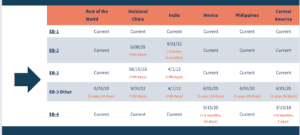
EB-3 Final Action Dates Chart October 2023
The final action date is based on the green card category and your home country. The final action date will fluctuate based on how many people from your home country have petitioned for the EB-3.
If green cards are still available, the final action date will likely move closer to your priority date. What if green cards are not available? If that’s the case, you will not see any movement from that final action date. If the limit has passed, you might see the date retrogress or move backward from your priority date. In the Visa Bulletin for October 2022 you will see that the Final Action date for India is currently April 1, 2012 and for EB-3 Other it’s the same. This is advanced 46 days from the previous bulletin. Discuss with your attorney the most up-to-date time for EB3 wait time India or other countries. In some cases, porting may be a better option for you.
What are the EB-3 Green Card Processing Fees?
- Consular Processing fee: $325 (employee)
- Permanent Resident Card: $220
Other fees may include the costs of advertisement for the PERM Labor recruitment process by the employer. You may also want to factor in the cost of hiring an immigration lawyer, which is optional and negotiable, but very important.
Immediate Relative Green Card
This particular visa category enjoys a higher preference over other family-based green card types for two major reasons. It does not have an annual limit, meaning there is always there is an unlimited number of visas so long the applicant and the sponsor are eligible.
Also, immediate relative applicants don’t have to worry about the green card waiting line as in other categories. The adjudication process starts as soon as the I-130 petition is received by the USCIS. Once it is approved, the green card will immediately become available.
Increase Your Chances of Family Green Card Approval
Family-Based Green Card Processing Time for Immediate Relative Applicants
Because green cards are always available for this category, both the U.S. sponsor and the beneficiary are allowed to file their I-130 petition and I-485 status adjustment form at the same time, provided the applicant is in the U.S. under a non-immigrant status.
The two forms can be processed concurrently to ensure a short processing time. The waiting period for this will depend on the service center in charge of your application. You can check the most up-to-date service center processing times with the USCIS processing times tool.
Say for example, you are filing an AOS to get a marriage green card. If the spouse is a U.S. citizen and the foreign partner is living in the U.S. then it will take about 8-12 months to get a permanent resident card. In the meantime, you can also apply for a work permit as well as advance parole travel documents while you wait to get your green card. If the foreign partner is outside of the U.S., then the process takes a bit longer (16-18 months). If the I-130 is for a permanent resident filing for a spouse or child under 21, the processing time is 16-30 months.
Whether you are in the U.S. or outside of the U.S., we can make your immigration process much easier. We will be with you every step of your immigration journey – from application to approval. At VisaNation, we make sure that your application is complete right, the first time, eliminating unnecessary delays. Get started today!
For immediate relatives outside the U.S., concurrent processing is not allowed. You will have to wait for the I-130 petition filed by your sponsor to be approved and wait for your priority date to become current before you can apply for a family-based green card through consular processing at a U.S. embassy or consulate in your country of residence.
Find out how you can Track Your Green Card.
Family-Based Green Cards are Easy and Simple with VisaNation
The processing time at this point will be dependent on the caseload at the embassy or consulate. You will need to factor in the immigration interview schedule and other consular processing requirements.
Understanding which category your family members fall into is crucial in estimating timelines for family-based immigration. Longer wait times can be draining and the process can become tiresome. At VisaNation, we aim to help you submit your application as fast as possible to shorten your immigration journey. Start today!
How VisaNation Law Group Attorneys Can Help
Having to wait for a green card priority date to be current can be difficult, and you may want to see what your options are when it comes to shortening this waiting time. Also, if you are in the process of considering petitioning for a green card, the idea of having to wait decades could be terrifying. That’s why it’s always best to discuss your situation with a qualified and experienced immigration attorney to ensure that you are making the right decisions when it comes to your green card.
Here at VisaNation, we have helped countless people like yourself obtain their green cards. From filing the petition and fees to dealing with Requests for Evidence and facilitating green card porting, VisaNation law group lawyers are here to take the stress out of your immigration process.
To get in touch with our office, you can fill out this contact form and schedule a consultation with us today.
The Visa Bulletin
Every month, the Department of State releases a visa bulletin that contains charts with all of the green card categories and the countries that apply for them. For each category and for each country, there is a date that is called the “final action date”. This is essentially where the DOS is when it comes to processing petitions. If the final action date reads June 8, 2014, then everyone who has a priority date of June 8, 2014 or older will have green card numbers issued to them that month. So, you will have to wait until the final action date matches or passes your priority date before you can receive a green card number.
Note that, while your priority date is set and does not move, the final action dates change from month to month.
What Goes Into the EB-3 Process?
In order to get this green card, you must go through the usual employment-based green card process.
Family-Based Green Cards Categories and Processing Times
Family-based green cards can be broadly grouped into two categories. They are the immediate relatives of U.S. citizens and the family preference category.
This second category is for specific, more distant family members of U.S. citizens and some specified family members of lawful permanent residents. It consists of four subgroups, F1, F2, F3, and F4. You can see the breakdown of green cards allocated per category per year below.
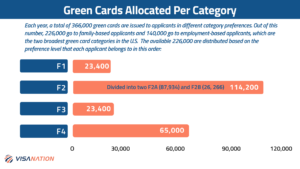
The relationship between the petitioner and the sponsored foreign national will determine the processing time for the green card application. Not sure which category your family members fall into? We can help you with every aspect of bringing your family to the U.S. Get started today!
Family-Based Green Card Eligibility Criteria for Foreign Nationals
As a foreign national family-based green card applicant, you must also prove that you have a qualifying family relationship with your sponsor and that you will not become a public charge upon arriving in the U.S. This means your sponsor can support you financially until you can support yourself.
Family-Based Green Card Processing Time Frequently Asked Questions
How can I submit a service request if I think my case is taking too long?
The first step would be to consult your immigration attorney to gauge whether your case is taking longer than it normally should. If your case is considered outside of normal processing times (longer than the time it takes to complete 93% of cases or beyond 130% of the cycle time), USCIS will provide you a link to submit an inquiry.
What affects the length of processing time?
A number of factors include:
What is the I-130 processing time for brother and sister in 2023?
Since brothers and sisters are not considered immediate relatives (they are in the F4 category), they have to wait for a permanent resident card to become available. It has an annual cap of 65,000 and hundreds of thousands of people apply. Wait time can be anywhere from 2-5 years or longer. They have to wait for the priority date and visa bulletin date to become current.
What is the I-130 processing time for parents in 2023?
The median I-130 processing time for immediate relatives (spouse of a U.S. citizen; unmarried child under 21 years of age of a U.S. citizen; or parent of a U.S. citizen (if the U.S. citizen is 21 years of age or older) averages 10.2 months. USCIS is taking steps with increased technologies and staffing to speed up processing times.
What is the green card waiting time for India?
Check the latest Visa Bulletin to see current times for India. Check which category you fall into F-1, F-2A, F-2B, F-3 or F-4. The Dates for Filing chart determines when an applicant can file an I-485, Adjustment of Status. If a particular immigrant visa category is “current” on the Final Action Dates chart or the cutoff date on the Final Action Dates chart is later than the date on the Dates for Filing chart, applicants in that immigrant visa category may file using the Final Action Dates chart during that month.
It’s a hard task to keep track of the final action dates for your family members and know which forms to submit. Let us make the process easy for you. Create your account today!
I am a U.S. citizen petitioning for my parents. How long does it take in 2023?
The I-130 average processing time is 6 to 12 months for immediate relatives. If your parents are already in the U.S. you can file Form I-485 at the same time.
I am a U.S. citizen petitioning for a brother or sister. How long does it take in 2023?
If they are within the U.S., you’ll need to file Form I-130, wait for a visa to become available and then file Form I-485. Wait times are typically years. Consult with your immigration attorney about possible alternative options to help them immigrate to the U.S.
Porting a Green Card
So what should you do if you’re looking at decades of waiting time for your priority date. Well, if you are getting an employment-based green card, you may have heard of having the option to “port” your green card from one preference level to the next. While this sounds like an optimal situation and it is technically possible, there are some things to note before getting started.
For one, it is not porting in the sense that all of your forms and information will simply be transferred to another green card preference level. In reality, your employer will need to file an completely new petition, fees, and obtain a new PERM Labor Certification on your behalf. It is essentially like starting over from scratch.
How it benefits you is because “porting” your green card allows your employer to indicate that your original green card priority date should be retained. That way, you can avoid having your priority date reset and your waiting time will be subject to the new final action dates listed in the bulletin for the higher preference level. Let’s look at an example:
Martha is an Indian citizen waiting on an EB-3 green card with a priority date in March 2016. It may be many years before her priority date is current. If she then petitions for an EB-2 green card in January 2019 and is approved, then her priority date will be retained at March 2016 rather than resetting to January 2019. If the EB-2 final action date for India is current, then Martha can adjust her status or use consular processing as soon as her petition is approved rather than wait several years.
However, there is a catch. In order to “port” your green card to the next level, you must not only obtain the qualifications for the new level, but you must also obtain a new job that requires your new qualifications. This can either be through your current employer or with a new one. Let’s take a look at the example again:
Martha applied for an EB-3 as a software developer. While she was waiting, she obtained a master’s degree in computer science. In order to port her EB-3 status to EB-2, she will need to either be promoted to a higher position that requires her master’s degree or she will need to find a new job that requires the degree.
This can be done for most employment-based green cards and does not have to go from an EB-3 to an EB-2 or an EB-2 to and EB-1. It’s all about the priority date. It doesn’t matter which green card you applied to before or which you are pursuing now, you are essentially starting from scratch on all aspects except for the priority date. Speak with your immigration attorney to see if green card porting is appropriate for your case.
Generally, family-based green card applicants can expedite the processing time by having the petitioner file the I-130 petition properly and submit all the required documents. This, however, will only have an impact on the I-130 petition.
There is another option for beneficiaries who are F2A applicants. If the sponsor becomes a citizen while they are still in the green card waiting line, they will be able to expedite the process. In this case, your sponsor will need to send a letter to the National Visa Center indicating that he or she is now a citizen. This will pave the way for your green card application to be processed as an immediate relative of a U.S. citizen.
What is My Green Card Priority Date?
Most people that petition for a green card have a priority date. In fact, if you petitioned for a family-based or employment-based green card, you most certainly have a priority date. This date will be printed on your notice of receipt from the USCIS and should be noted as one of the most important dates concerning your green card processing time. So what is a priority date?
It is the day that the USCIS receives your green card petition.
This date shows what your priority level is according to the Department of State. Therefore, you will have to wait until they have processed all of the petitions that were submitted prior to yours before your petition will be processed.
Why is your priority date important? The Department of State has an annual limit on the number of green cards it distributes to any country from any category (e.g. EB-3 green cards to Chinese citizens). If too many people from a single country petition for the same green card in one year, a backlog will build up, and the DOS will process petitions in order of their priority dates.
What should you do with your priority date? You’ll have to compare your priority date to the final action dates that are posted in the visa bulletin.
Why Is It Longer For Some Countries Than Others?
You may notice that the dates for some countries are different from others. Some countries have dates that move forward every month while others have dates that don’t move at all or actually go backward in a process called “retrogression”.
This is not due to any prejudice on the part of the Department of State. This is due to the fact that some countries submit many more petitions than others. Heavily-populated countries such as China or India usually exceed the annual limit on green cards across several different categories, causing backlogs to build and dates to retrogress. Countries that submit fewer petitions than the limit will see their final action dates move forward.
If the final action date moves forward until it matches the current calendar date, it will be considered “current” (marked by a “C” in the bulletin). If your category is current, then you can move forward with adjusting your status or consular processing as soon as your petition has been approved. However, others will have to wait until the final action date passes their priority date in order for their priority dates to be considered current.
However, for those populated countries that regularly submit more petitions than their limit, priority date waiting times could take decades to become current, if they ever become current at all.
Family Preference Green Card
Unlike the immediate relative category, the family preference category has certain factors that create limits on these visas. These factors heavily determine the family-based green card processing time.
For instance, each of the subcategories in the family preference has an annual limit for immigrant visas issued each year. Once this number is reached, other applicants in that category will have to wait until the next fiscal year. Also, no country can make up more than 7% of the total visas issued in any given year. Once this percentage is reached, other applicants from that country will have to wait until the next fiscal year.
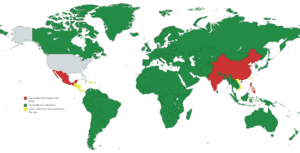
This can cause some applicants to have to wait for several years before they are able to adjust their status. Therefore, the processing time will largely depend on two main factors, one of which is the family preference subcategory you are pursuing:
Family First Preference (F1): This subcategory of the family-based green card is for unmarried sons and daughters of U.S. citizens and their children under 21. Its annual cap is 23,400.
Family Second Preference (F2): This is for children under 21, spouses, and unmarried sons and daughters (who are 21 years old and above) of lawful permanent residents. Its annual cap is 114,200. 77% of the green cards in this group are issued to children under 21 and spouses (F2A), while the remaining is allocated to unmarried sons and daughters (F2B).
Family Third Preference (F3): This is for married sons and daughters (of any age) of U.S. citizens, and their children under 21. Its annual cap is 23,400.
Family Fourth Preference (F4): This subcategory is for brothers and sisters of U.S. citizens, as well as their children under 21 and spouses, provided the U.S. citizen sponsor is at least 21 years old. It has an annual cap of 65,000.
The second factor is based on the applicant’s country of origin. Sometimes, the wait times for some applicants may be much longer than the average time. This is because certain countries usually exceed their 7% annual limit for each category, which leads to visa application backlogs.
If you are from any of these countries, you may be affected by this quota. Applicants from countries like India, the Philippines, China, and Mexico may have to wait for 10 to 20 years, depending on the visa backlogs for their subcategories. We make family-based immigration easy. Start your application today!
Family Preference Green Card Processing Times
Due to the annual limit attached to these green cards, the processing time is calculated by adding the I-130 processing time and how much time you will spend waiting for your green card priority date to become current.
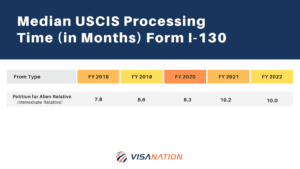
I-130 Processing Time
This is the first step when filing a family-based green card application. This petition must be filed into the USCIS by a U.S. citizen or green card holder and must be accompanied by the required documentation to show eligibility and a qualifying family relationship.
Once the USCIS receives your petition, you will be notified via a receipt by mail. If the petition is approved, the sponsored foreign national will then need to wait until a green card is available for their category.
There is an exception to this for applicants who are immediate relatives of U.S. citizens. As mentioned previously, they do not need to wait for a visa number as there is always an immigrant visa available for them the moment the I-130 filed on their behalf is approved.
The sponsoring family member can also expedite the process by filing both the I-130 and the I-485 adjustment of status application at the same time, as long as the beneficiary is in the U.S. Applicants who do this usually get their green cards within 6 to 12 months. Immediate relatives outside the U.S. will need to wait for the approval of their I-130 before they can apply for a green card.
Reunite with Your Family Sooner
Adjustment of Status vs Consular Processing
Once your priority date is current and your I-140 is approved, you will be able to go through one of two routes to get your green card. The first is through adjustment of status. This is only available for those that have a nonimmigrant status to adjust in the first place. You must be currently in the U.S. under a nonimmigrant or temporary visa such as an H-1B, L-1, or E-2 visa. If this is the case, then you will simply need to file an I-485 with the USCIS and wait the approximate six months it takes for the form to be processed.
On the other hand, those who are not in the U.S. under a nonimmigrant status must go through . This involves making an appointment with a U.S. consulate or embassy in your home country. It may take a few weeks to a few months from scheduling to appointment. Once you’re at the embassy, a consular officer will interview you to determine if your case is legitimate. He or she may ask you basic questions (such as who your employer is) or more specific questions (such as what your plans are in the U.S.) or a combination of both. The goal is to ensure that you are who you say you are and that your intent to live permanently in the U.S. under EB-3 status is above board.
Consular processing is an option that is available to those who qualify for adjustment of status. In some cases, it can not only be the less expensive option, but it can also be the faster one. The I-485 takes about six months to process and, as we’ll see in a moment, premium processing cannot speed this time up. If a consular interview will take place in a few weeks, it could be a better option in terms of your overall EB-3 processing time.
Can Premium Processing Help?
Fortunately, the USCIS offers an optional service to expedite the process of all visa petitions that use the I-129 or I-140 forms. By paying an additional fee of $1,440, you can shorten the processing time of your petition to 15 calendar days. However, this does not expedite any other step in the EB-3 process.
It is also important to note that, if your priority date will not be current for some time, premium processing may not help, as you cannot adjust your status until your priority date is current, even if your I-140 is approved. Also, premium processing will not increase your chances of having your petition approved. Speak with your immigration attorney to learn if this feature is right for your case.
What about Porting?
Because the wait times can be so long for certain priority dates, there are situations where an applicant gains the education or requirements necessary to upgrade his or her green card. If you originally applied for an EB-3 and gained your master’s degree while you waited, you could be eligible to reapply for an EB-2, which some people refer to as ‘porting’ (although, it isn’t so much porting as it is starting over from square one). You may also be able to retain your original priority date.
However, you would first need to get a different job that clearly required your new education. This can be achieved either through your current employer or with a new one. Here is an example:
Purna is an electrical engineer from India with his bachelor’s degree in that field. He applies for the EB-3, but his priority date will not be current for almost ten years. So, he continues his education and gets his master’s degree. In order to re-apply for an EB-2 under this new qualification, Purna needs to find a job either through a promotion or with a different employer that makes use of his new master’s degree.
If you are eligible to port your green card and you have found a suitable job, the employer that is sponsoring you for the new green card will need to obtain a new PERM Labor Certification for you before filing another I-140. Because this is a delicate process, always work alongside your immigration attorney in cases such as these.
What Goes into Consular Processing
Once the USCIS has approved the I-140 filed by your employer, your case will be forwarded to the National Visa Center (NVC), which will assign a case number for your petition. When your priority date meets the most recent final action date, you will be notified to complete the DS-261.
The DS-261 is an online form that requires you to provide your personal information to help give the state department details on channels of communication throughout the application process. After successfully completing the DS-261, you will need to print the confirmation page of the form, as that will be included in your supporting documents.
Complete the Immigration Medical Exam
Before your interview date, you will need to schedule and complete certain medical examinations and vaccinations. The results will be part of the criteria to determine your admissibility to the U.S.
Prepare Your EB-3 Green Card Supporting Documents
NOTE: Depending on the embassy and the individual’s case, the supporting documents may vary from what has been listed here. You will need to check with your attorney to be sure that you have the required documents for your case.
Attend Your Visa Interview
Upon receiving and reviewing your supporting documents, the NVC will schedule a visa interview for you at the consulate or embassy. If all goes well at the interview and your visa is approved, the NVC will send you your passport containing your immigrant visa and a sealed package. These are all you need to travel to the U.S. Do not open the sealed package–it should only be opened by an immigration officer when you get to a U.S. port of entry. Once you have been admitted to the U.S., your employment-based green card (I-551) will be mailed to you.